
Zener Diode: Working, Symbol, Features & Uses
A Zener diode works like a regular semiconductor device yet lets electricity move both ways – once the reverse voltage hits a certain point called the Zener breakdown level. Unlike standard diodes, it handles backward flow without failing, if thresholds are reached. This behaviour kicks in due to heavy doping, making it conduct under high reverse stress. Instead of blocking current, it starts passing it once that critical voltage appears across its terminals.
A popular pick for electronics, this part keeps the output steady even when power shifts or demand changes – thanks to its ability to hold voltage stable under varying loads.
What is This Diode?
It comes from a tightly doped p-n combo – once the voltage hits Vz, it lets current flow even backward. Instead of blocking reverse voltage like normal, this one switches on at that point. Doping makes it act different under pressure from opposite direction.
Instead of failing under high reverse voltage like regular diodes do, Zener types are built to work without issues once breakdown starts.
A basic way to put it: a Zener diode works like a steady voltage helper, keeping the output stable in power setups or safety designs – using it helps avoid wild swings when things get shaky.
Zener Diode Symbol and Construction
its symbol is like a regular diode; yet it’s got curved tips on the cathode side, showing how it handles breakdown. While.
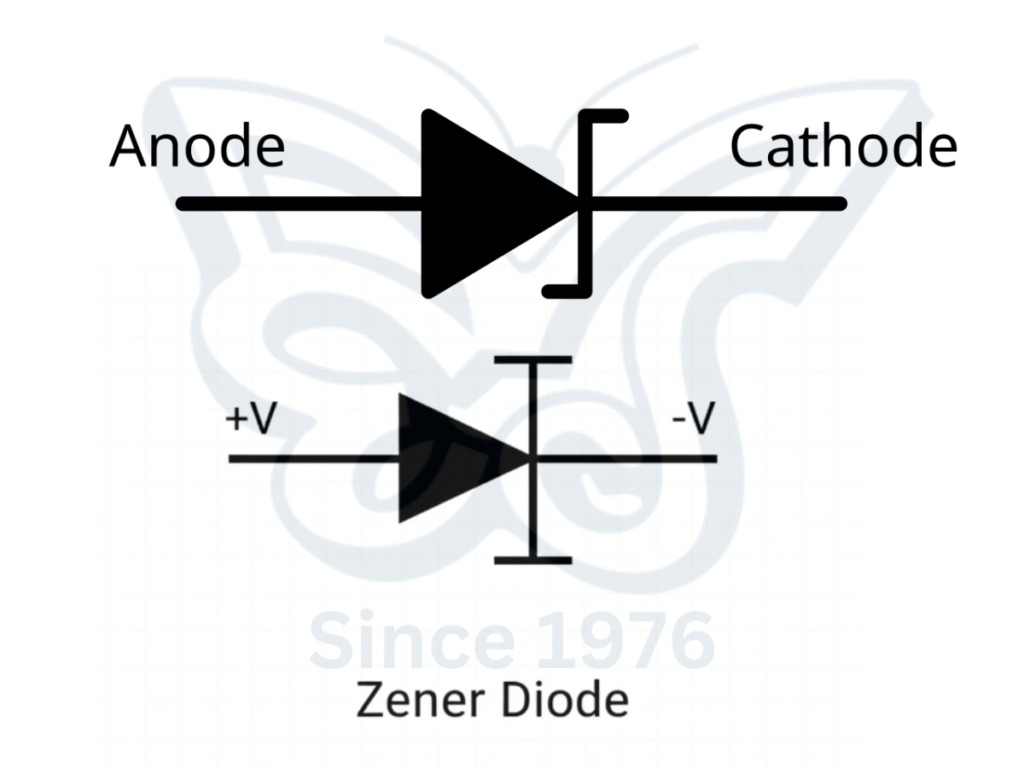
- Construction Details:
- A thickly charged p-n joint makes it up.
- The doping level’s greater compared to a regular diode so it hits breakdown faster.
- The connection’s covered by a casing made of glass or plastic to guard against heat and physical damage.
Working Principle of Zener Diode
It runs when it’s reversed, meaning voltage pushes the wrong way. Once the reverse voltage hits the Zener breakdown level, plenty of charge carriers break free – so current moves through the diode yet the voltage stays steady across it. One-way things fall apart through stress over time – another’s sudden force hitting hard.
- Zener breakdown happens when voltage is low – less than 5 volts – because the electric field gets too intense.
- Avalanche breakdown happens when voltage gets high – charge particles smash into each other, triggering a chain reaction.
Zener Diode as Voltage Regulator
A typical use for a Zener diode? Keeping voltage steady – though it can also work in other circuits where stable levels matter.
Circuit Description
A typical use for a it? Keeping voltage steady – though it can also work in other circuits where stable levels matter.
- A resistor named Rs links up with the Zener diode one after another to keep the flow under control.
- It gets hooked up backward across the load.
- As the input voltage goes up, the Zener starts carrying extra current, so the load keeps seeing steady voltage.
- This keeps the output voltage steady despite shifts in input or variations in the current load.
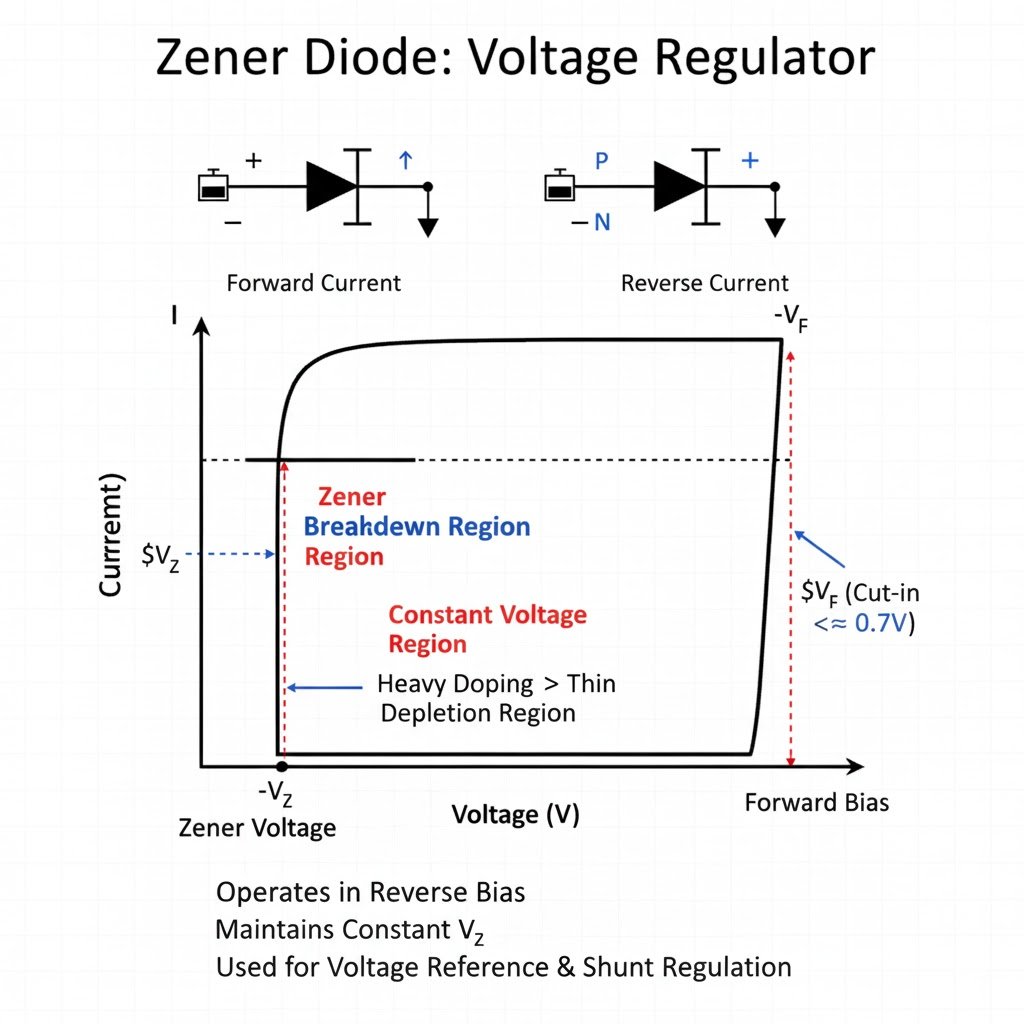
VI Characteristics of Zener Diode
- The VI graph of a Zener diode reveals how voltage ties to current – though it shifts once breakdown hits; this behavior sets it apart from regular diodes since conduction runs backward under certain conditions while maintaining near-constant voltage despite rising flow.
Forward Bias Region
Like a regular diode, electricity moves once voltage hits about 0.7V – silicon needs that much to get going.
Reverse Bias Region
- When voltage’s low, the flow of electricity hardly matters.
- Once the voltage hits the Zener breakdown level (Vz), current jumps fast – yet the voltage stays almost steady.
- Graph Note: The level part under reverse voltage hints at steady output despite changes.
Applications of Zener Diode
- Zener diodes pop up in nearly all today’s electronic setups.
- Key uses cover things like:
- Keeping voltage steady inside power circuits.
- Shield delicate parts from sudden power surges using overvoltage defense.
- Waveform Clipping – Found in clamp setups or used when signals get cut off.
- Reference voltage – acts like a steady benchmark in amps and chips, sort of tied to consistency without drifting much due to changes around it.
- Flip circuits – Handle signals while adjusting logic levels.
Advantages and Limitations
Advantages:
- Maintains constant voltage.
- A basic setup that works without fail.
- Cheap but easy to find.
- A quick reaction when voltage shifts happen.
Limitations:
- Limited ability to manage voltage plus load.
- Changes in heat might impact how much voltage something can handle before failing.
- Won’t work well when dealing with high voltage control.
Difference Between Zener Diode and Normal Diode
Feature | Normal Diode | Zener Diode |
Forward bias operation | Conducts | Conducts |
Reverse bias operation | Blocks current, damaged if breakdown | Conducts in reverse without damage at breakdown voltage |
Doping level | Moderate | Heavy doping |
Breakdown voltage | High, damage if exceeded | Sharp, controlled breakdown |
Usage | Rectification, switching | Voltage regulation, protection |
Frequently Asked Questions (FAQ)
Q1: What is the purpose of a Zener diode?
A Zener diode keeps voltage steady over a load – so it works well in circuits that need stable power or safeguards. While it doesn’t boost signals, it holds voltage flat even if current shifts. This trait helps where consistent levels matter more than speed. Instead of reacting fast, it focuses on balance under changing conditions.
Q2: What happens when a Zener diode is forward biased?
- It acts like a regular diode, only letting current through once it hits about 0.7 volts.
Q3: What is Zener breakdown voltage?
When the diode gets a certain backward push, it begins letting current flow the wrong way, holding steady voltage across it.
Q4: How to test a Zener diode using a multimeter?
- Try the diode setting – check voltage drop going one way (~0.7V), while blocking flow shows very little current passing back.
Conclusion
- The Zener diode stands as a key part in today’s electronic devices, yet it works quietly behind the scenes.
- Keeping voltage steady is why it’s so useful in power setups, safety designs, or places needing a reliable voltage baseline.
- Knowing how it works, what it looks like, its features, also where it’s used, gives you a solid start in electronics plus building circuits.
For visit my office and see more products please follow the link – Google My Business
Also visit our Instagram and Facebook page too.
Office Address: 1st Floor Krishna Building, Shamrao Viththal Marge, Grant Road east.Mumbai – 400007
Phone: 9167608067
Email: sales@mscpl.com
Website: https://mscpl.in